I. What is the business model Canvas
To assess the state of its business in relation to its economic model, the Business Model Canvas is a tool that proves to be useful and effective.
Creating your Business Model Canvas is ideal when starting your business, as it allows you to have a general idea of its economic potential. The Business Model Canvas is now a widely used tool in the business world, due to its simplicity, as well as its speed and effectiveness.
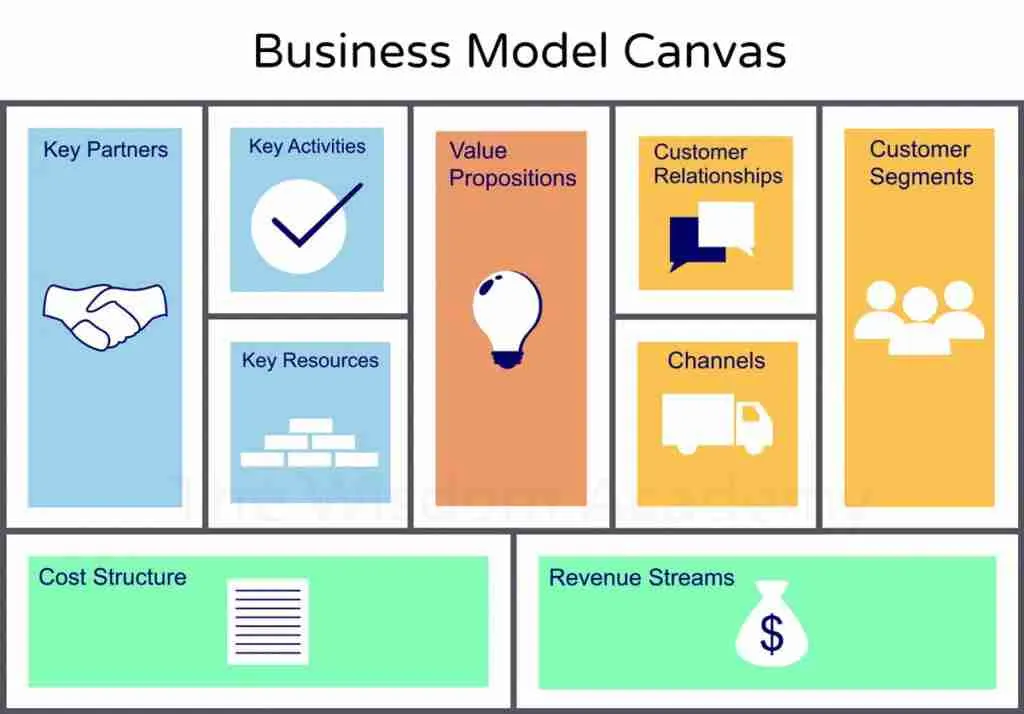
There are different approaches to creating a Business Model Canvas, but the most commonly used today is the Business Model Nouvelle Génération d’Alexander Oswalder et Yves Pigneur a new concept of business model that allows for better differentiation and value creation. This approach enables the entire business model to be represented on a single page, through a canvas.
Why use the Business Model Canvas ?
The Business Model Canvas allows you to represent your entire economic model on a single page, through a canvas. Once completed, you will be able to define your priorities by clearly showing what you need, the steps to be taken, and the areas for improvement.
Small practical exercise to get off on the right foot with the BMC
To begin with, even before embarking on the creation of a Business Model Canvas for your business, it is important to get organised. The few preparations we list here will help you start off on the right foot.
Gather the appropriate equipment
First of all, it is important to ensure that everything we need is available. This includes markers, post-it notes, scissors, tape, pencils, erasers, and all the supplies that could facilitate collaboration and the bulk sharing of ideas. It is also essential to print or draw the matrix on a large sheet of paper and hang it on the wall in order to represent your business model.
Surround yourself with an enthusiastic team !
An enthusiastic and creative team is the foundation of an effective and prosperous business. With a good core team, the BMC will only be developed better.
That said, at the time of starting a business and before creating the Business Model Canvas, it is important to surround oneself with enthusiastic, effective, and qualified people. The individuals who should participate in the development of the Business Model Canvas need to be motivated and positive.
The environment has a direct impact on the quality of the BMC and the future business of your project, so this is an aspect that should not be overlooked.
Awaken your creativity
Find Post-its, draw, cross out, list your contacts, staple notes, ... and thus move from idea to action more quickly. A good drawing is worth more than a long speech !
II. The components of the Business Model Canvas
What is the BMC actually made of?
If you are wondering what the components of the Business Model Canvas are and how many there are, we will answer that in the BMC, we can count 9 components and these components are as follows:
- Customer segmentation.
- The value proposition.
- The channels of acquisition and distribution.
- Customer relationship.
- The revenues.
- Key resources.
- Key activities.
- Key partners.
We will take care to detail these 9 components for you in the following lines.
Now, let’s take a closer look at the 9 components of the BMC method, along with the definition and explanation related to each of them. An interactive model has been integrated here so that you can better understand this tool.
1. Customer segmentation
When starting a business and developing its economic model, it is important to embark on discovering the customer and getting to know them. Therefore, it will be necessary to identify the general profile of your customers, considering various criteria such as: their age group, where they come from, their geographical location, etc. It is essential to precisely identify the target audience for the project from both a social and economic perspective, as well as their specific needs related to the product you wish to offer.
Segmentation will allow you to know who your business/project primarily targets. It will subsequently help you to tailor your service or product offerings to suit the nature of your clientele.
2. The value proposition
In light of customer segmentation, you will be able to formulate an offer that best meets their needs and various situations. To determine your company's value proposition, you need to answer a number of questions. The value proposition is the value that your company will bring to customers: how the service or product you offer will address their needs, and what problems or gaps you will help to resolve.
Furthermore, it is wise to analyse the added value of your business in relation to the market. This means you need to ask yourself what you will bring that is additional compared to the competition. It is important to have your own specificity, to offer something that cannot be found elsewhere.
Finally, the value proposition also involves identifying the combination of products or services that you will offer for each of the different customer segments previously identified.
3. The distribution channels
Determine by what means you will deliver your products and/or services to customers. What channels will you consider for the promotion and distribution of these? Will you use the internet? Do you plan to set up in a supermarket (a physical location)? Will you participate in trade shows? These are all possibilities to consider depending on the product or service you offer.
It is important to define which distribution channel is most suitable for your different customer segments.
4. The source of income
This involves identifying the various revenue streams of your business. Revenue streams are the different financial sources generated by your business activities. This can come from direct sales, paid subscriptions, fees, rentals, and many others. What will your business model be and how do you plan to generate revenue?
5. Customer relationship
Identifying the means by which you will interact with the different segments of your customers is of paramount importance. It is also a matter of developing a communication strategy that will allow you to attract new customers and retain existing ones. The means of communication are numerous: the internet, advertising, blogs, etc.
6. The identification of resources
Identify the material, financial, and human resources necessary for the creation of your business and the launch of your activities.
7. Key partners
In addition to the resources you will bring, it is possible to resort to partnerships. These will allow you to start the business even if you do not have the necessary resources. It is important to choose quality partners who will help you create value and meet your needs. You may need a supplier of raw materials, for example, or a service provider for the promotion of your services or products.
8. The main activities
Here, you will determine all the activities necessary for the operation of your business. This may include software development, setting up a distribution chain, etc.
9. The cost structure
Last point, structure and identify all the costs of your business. This involves the financial means to be implemented to launch your activities, maintain relationships with your clients, promote your products and services …
You must also identify the priority costs, as well as the fixed costs and variable costs.
We suggest you use our ViviTool in order to generate your Business Model Canvas by answering a few questions
Why use the Business Model Canvas ?
The Business Model Canvas is a summary of your Business Model. It allows you to represent your entire economic model on a single page, through a canvas. When the BMC is complete, it enables you to correctly define your priorities by highlighting at a glance what you need, the steps to be taken, and the areas for improvement.
When should a business model canvas be created ?
In reality, the business model canvas starts as soon as your target customer segment is known. It is the knowledge we have of the customers and their characteristics that leads to the completion of an effective and relevant market study, both from a macroeconomic perspective.
To share :
Commencez à écrire ici ...